Real-asset rooms, investor eligibility, transfer controls, servicing, covenants, and reporting.
Global financial hub layer
Sovereign-grade financial infrastructure for tokenized real-asset finance, regulated programmable money, and institutional market operations.
Ten rails on one evidence-native substrate. Three patents pending. Built for AAOIFI, IFSB, FATF, MiCA, FINMA, VARA, ADGM, DIFC, SAMA, CMA, CBB, BNM, and MAS diligence pathways. Hybrid post-quantum security posture. Formal-verification work for Islamic-finance arithmetic.
Global hubs
Evidence packets
Policy-bound flows
What SAFI is
One institutional operating layer for regulated money, markets, real assets, and reviewable evidence.
SAFI is sovereign-grade financial infrastructure for tokenized real-asset finance, regulated programmable money, and Islamic structures. Ten coordinated rails on one evidence-native substrate. Built so a Swiss credit committee, a Sharia Supervisory Board, a Saudi central bank examiner, and a Singapore venue supervisor can independently verify the same workflow without trusting any operator's database.
01L1 substrate
Determinism-first chain substrate, state commitments, replay, recovery, and validator architecture for sovereign-grade deployments.
02VERIFY
Reviewer-portable proof bundles for auditors, regulators, and boards to re-execute selected workflows independently.
03Tokenization
Asset room, offering workflow, issuance controls, servicing, redemption, default evidence, and real-asset lifecycle support.
04Vault
Custody-control evidence, HSM-bound ceremonies, recoverable backup posture, and migration-event packets.
05Money rail
Policy-bound programmable settlement above approved bank, stablecoin, CBDC, or regulated payment rails.
06Compliance
KYC, AML, sanctions, FATF Travel Rule, and jurisdictional evidence packets for regulated partners.
07Market spine
Rulebook versioning, order-lifecycle journal, surveillance evidence, durable ingress, and trade-bust workflows.
08Remittance
Originator, beneficiary, sanctions, corridor-policy, and partner handoff evidence for cross-border flows.
09PAYAGENT
Mandate, threshold, intent, decision, and receipt artifacts for bounded AI-proposed financial action.
10Islamic finance
AAOIFI and IFSB workflow evidence for Sharia-board review; boards attest, SAFI preserves the evidence.
Built for prudence-first capital
One institutional control layer. Six rail families.
Swiss and Gulf institutions do not need another speculative token story. They need controlled infrastructure that can survive legal review, custody review, Sharia review where applicable, and investment-committee scrutiny. SAFI’s thesis is to make regulated digital finance easier to inspect before it is scaled.
Core Evidence Fabric
signed decisions · Merkle evidence · offline verification · data-residency controls
Signed compliance decisions, audit bundles, reviewer workflows, and portable proof packages.
Dual-control approvals, vault state, signer posture, custody evidence, and migration planning.
Policy-bound disbursement, settlement evidence, reserve attestations, and corridor controls.
Bounded software-agent payment workflows, proof-of-intent, human thresholds, and denial evidence.
AAOIFI-informed review options, Sharia-board workflow evidence, purification state, and cashflow records.
Evidence before scale
The product is not a dashboard. It is a reviewer-verifiable operating record.
SAFI’s public story should be judged by the evidence package it can show in qualified diligence: what action happened, which policy allowed it, who approved it, what proof was produced, and what a reviewer can independently inspect.
Source event
Investor eligibility, Sharia review, custody approval, payment instruction, sanctions result, transfer rule, servicing event, or denial.
Policy context
Jurisdiction, product type, partner role, rulebook version, reviewer threshold, mandate boundary, and exception path.
Signed decision
Approval, rejection, escalation, or servicing state is preserved as reviewable evidence where implementation scope supports it.
Proof package
Merkle-style inclusion evidence, evidence bundle, audit export, and reviewer notes can be packaged for diligence review.
Independent review
Auditors, counsel, Sharia reviewers, trustees, and technical reviewers can inspect selected artifacts through an offline path.
Target diligence corridor
Swiss diligence, Gulf capital, and Islamic-finance hubs can meet on one evidence-native rail.
This corridor view is a strategic discussion map, not a claim of live routes, approvals, customers, or money movement. Each node requires local counsel, licensed partners, custody review, and product-specific controls before launch.
Partner-led
Counsel-gated
Evidence-first
No live corridor implied
Regulated launch boundary
SAFI should be presented as partner-led infrastructure until every product-specific gate is cleared.
Technical capability, demo quality, and investor demand do not replace licensing, counsel, custody, audit, insurance, regulator or sandbox evidence, and transaction-specific Sharia review where applicable.
RailPublic positionRequired before launchInvestor-safe language
Capital MarketsDemo and partner workflow for real-asset lifecycle evidenceIssuer approvals, transfer-agent path, counsel, custodian, eligibility provider, disclosure reviewNo public securities offering is made by this site.
Vault ControlCustody-control workflow and signer evidence surfaceRegulated custodian, HSM path, key ceremony, external audit, insuranceNo live-value custody authorization is claimed.
Money / RemittancePartner-led corridor controls and settlement evidenceLicensed partner, FX/settlement provider, Travel Rule operations, beneficiary controlsNo money transmission service is offered by this page.
Exchange / TradingSandbox simulation and surveillance workflowLicensed venue path, rulebook, surveillance SOP, market-integrity reviewNo live exchange, ATS, MTF, or trading venue is claimed.
Islamic Finance OpsWorkflow evidence for transaction-specific Sharia reviewQualified Sharia-board process, counsel memo, fatwa/minutes evidence, purification governanceSAFI does not certify Sharia compliance.
Institutional bottleneck map
The digital-finance opportunity is being delayed by control, evidence, and trust gaps.
SAFI should be evaluated as infrastructure for regulated partners: a proof layer for tokenized real assets, capital-markets servicing, custody workflows, compliance verification, remittance corridors, and bounded AI finance.
BottleneckInstitutional costSAFI rail responseEvidence shown
Fragmented tokenization stackSlow issuance, weak secondary liquidity, repeated reconciliationsReal-Asset Capital Workflow: asset rooms, eligibility, transfer rules, lifecycle servicingCapital Markets module, Tokenization, Digital Asset Rails
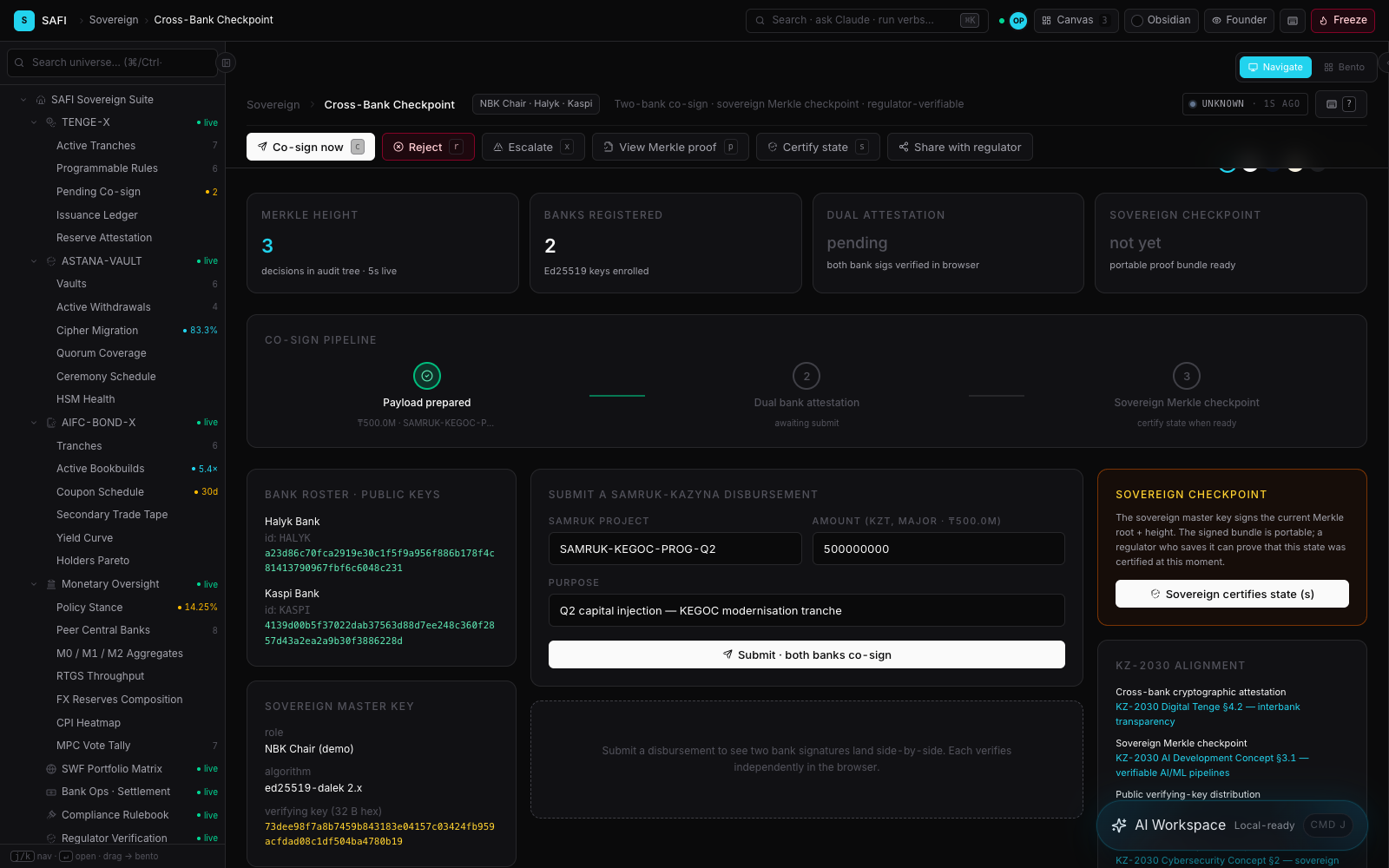
Compliance logs are not proofRegulators receive PDFs, screenshots, and vendor claimsPROOF Rail: signed decisions, Merkle roots, deterministic replay, offline verificationVerifier console, Cross-Bank Checkpoint
Custody and key-control riskLong-duration infrastructure assets need durable controls and audit stateVault Control workflow: dual control, vault state, key ceremonies, hybrid post-quantum migration designVault Control, signer service evidence
Remittance and payment frictionSlow settlement, repeated KYC, expensive corridors, opaque screeningProgrammable Money Rail: quote-time checks, corridor policy, beneficiary controls, receiptsMoney Rail, Diaspora Send, Payments Control
software-agent financial riskAutonomous systems can exceed mandates or create disputed authorityPAYAGENT Rail: bounded mandates, proof-of-intent, denial attestations, human thresholdsMandate Demo, audit exports
Islamic finance operations gapSharia approvals are document-heavy and hard to monitor after issuanceIslamic Finance Operations: AAOIFI-informed design, SSB workflow, purification and cashflow stateCapital Markets module, Sharia-review workflow evidence
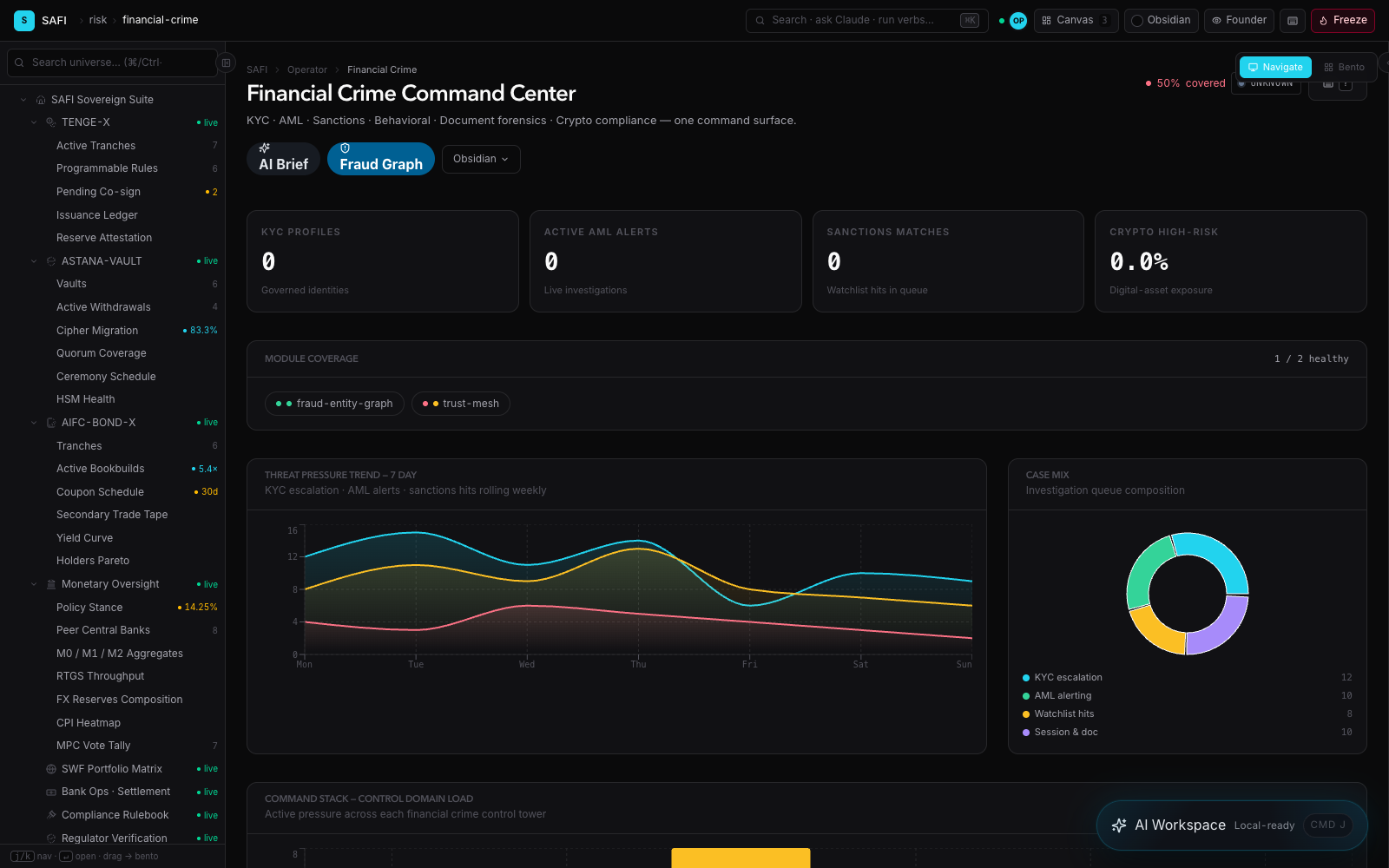
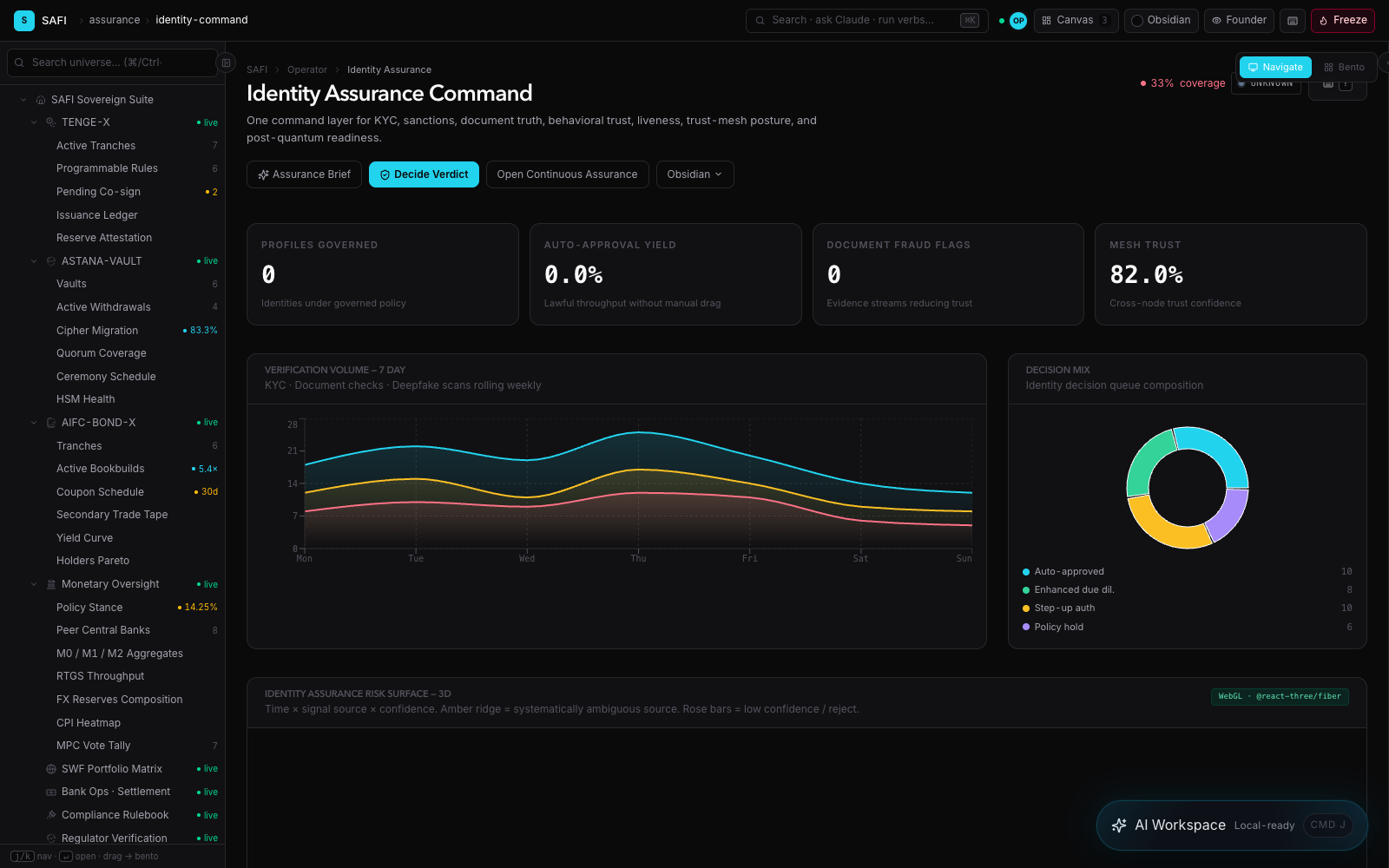
Software proof, not concept art
SAFI has current product surfaces that support diligence conversations.
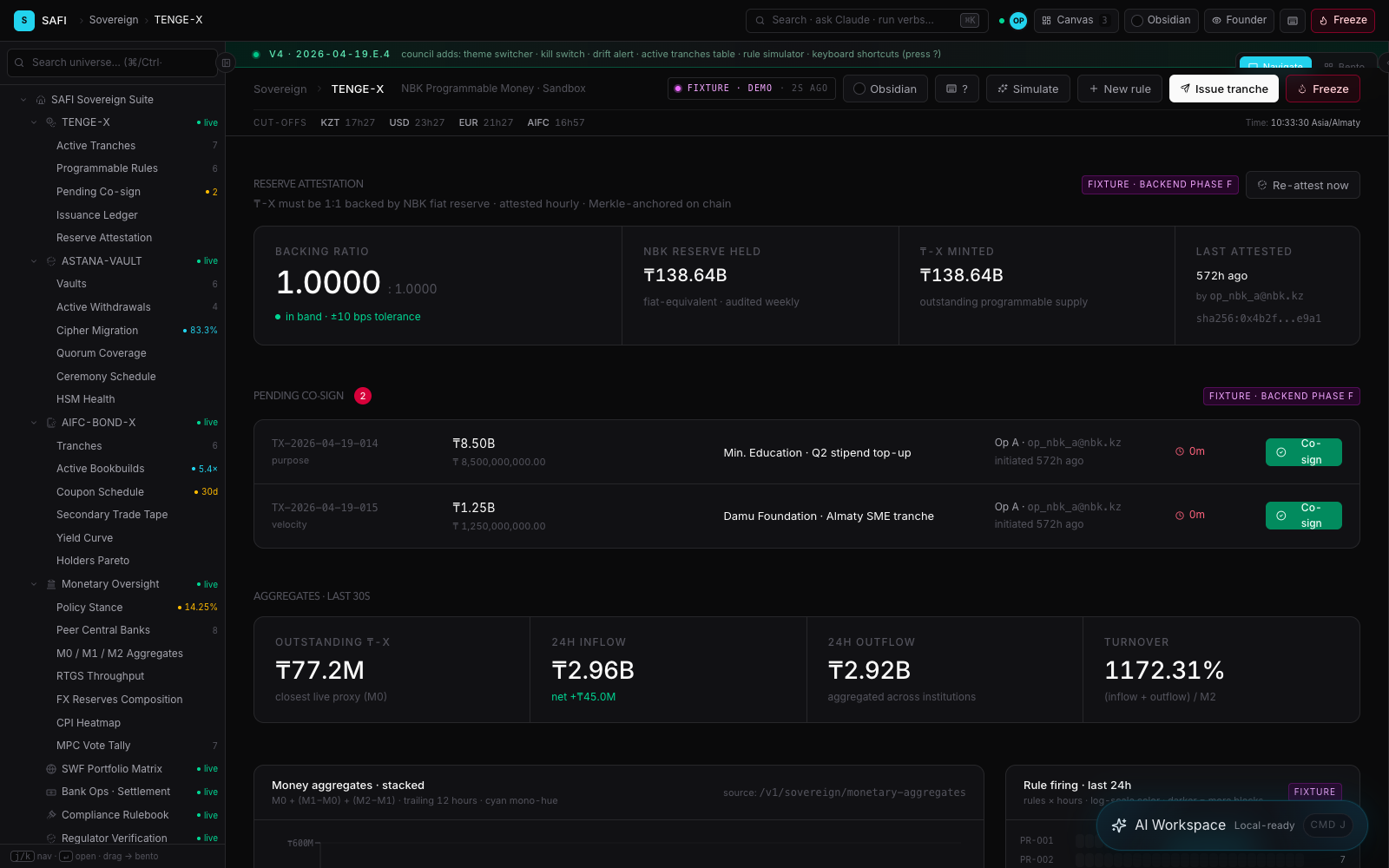
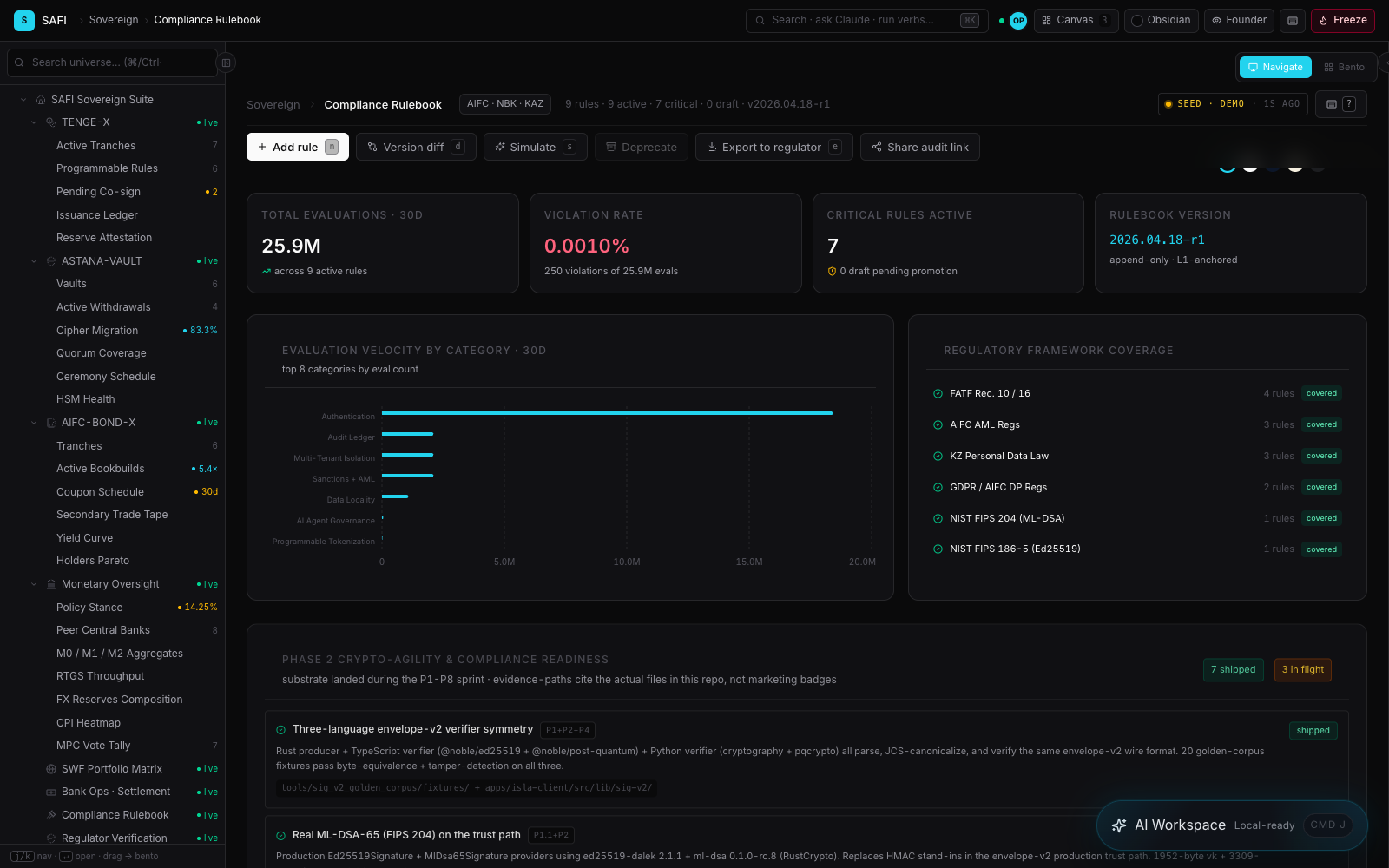
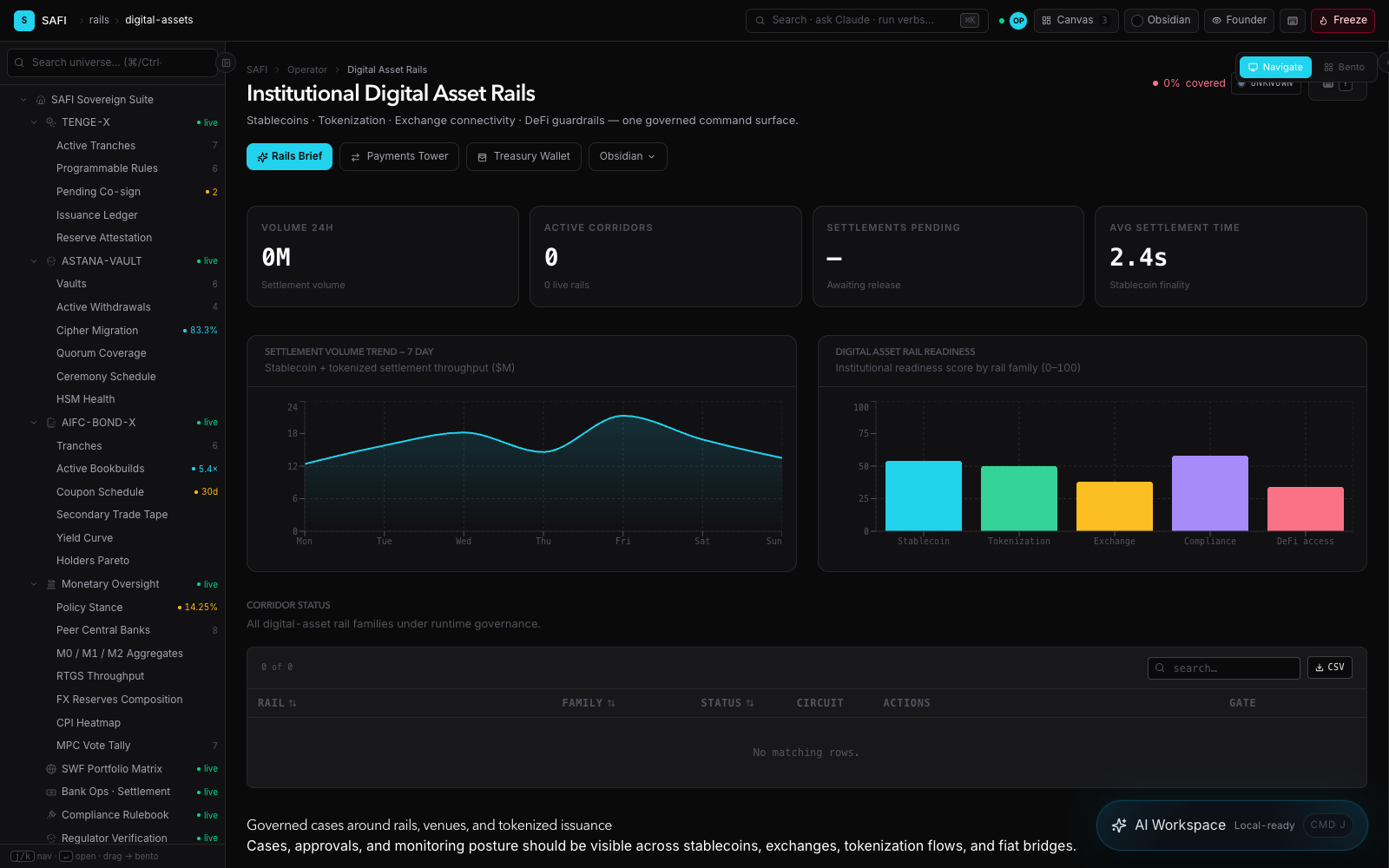
Each screen represents a SAFI product or demo surface mapped to a commercial rail, buyer workflow, and evidence package. Technical status, implementation scope, and production readiness should be reviewed in diligence.
SAFI trust spine
The deeper architecture is the evidence path beneath the interface.
This public view stays at capability level. Status labels distinguish active work, partial work, and roadmap items so the architecture can support diligence without overstating launch readiness.
Rust-native infrastructure layer
Rust-native components and validator-oriented design for regulated deployments where jurisdiction, identity, and operational policy matter.
CometBFT-compatible finality path
Consensus-compatible lifecycle work that can support controlled validator-set operation; no public mainnet readiness is claimed.
State and proof layer
State-key and proof-layer work intended to support signed decisions, Merkle evidence, and independent replay workflows.
Offline verifier
Standalone verification path for signed policy decisions and Merkle proofs, designed for evidence review without relying on live network access.
Hybrid signing posture
Hybrid post-quantum migration planning represented as security posture and workflow design, not as certification or production custody authorization.
Compliance invariants
Sanctions, Travel Rule, AML monitoring, prudential checks, large-exposure gates, and Islamic-finance review workflows can move toward stronger system invariants as partner and counsel reviews mature.
AI-native control and security posture
SAFI is built for AI and AGI-assisted finance where authority must be bounded, signed, and reviewable.
The important point is not that an AI can suggest an action. The important point is that no AI, agent, operator, or integration should be able to exceed a mandate without leaving signed evidence, denial evidence, and a reviewer-verifiable trail.
PAYAGENT mandate envelope
Mandate hashes, spend limits, proof-of-intent, human thresholds, allow/deny receipts, and forensic logs for AI-assisted financial actions.
Classical + post-quantum posture
Public-safe materials describe Ed25519 plus NIST FIPS 204 ML-DSA-65 migration posture at capability level, subject to implementation scope and audit.
RFC 6962-style Merkle evidence
Append-only evidence concepts using SHA-256 with domain-separated Merkle paths, inclusion proofs, and portable verifier packages.
Deterministic signed bytes
Canonical action records and idempotency logic are designed so replay, dispute review, and audit packages can compare the same signed facts.
HSM and key ceremony path
Dual control, signer posture, quorum records, segregation evidence, key ceremony planning, and custodian integration workflows.
Policy and residency controls
Jurisdiction, role, product, and data-residency context are treated as operating controls, not as marketing labels.
ZK sanctions lane category
Capability-level zero-knowledge sanctions/non-membership concepts are kept patent-safe and counsel-controlled until implementation and review scope are agreed.
Offline evidence review
Selected evidence bundles can be reviewed without requiring broad backend access, improving trust for auditors, counsel, trustees, and technical reviewers.
Market timing
The investable market is moving from crypto speculation to regulated digital finance infrastructure.
These are external market anchors. SAFI revenue, adoption, and platform value remain internal management scenarios unless supported by signed customers or regulatory approvals.
Tokenized real-world assets by 2030, with $55T by 2035. BCG excludes real estate and tokenized money, stablecoins, and repos from this sizing.
Source: BCGGlobal Islamic financial services industry assets in 2024, up 14.9% year on year.
Source: IFSBGlobal sukuk issuance in 2025, up from $234.9B in 2024 under S&P's broader local-currency measure.
Source: S&PPredicted tokenized real estate by 2035, from less than $0.3T in 2024.
Source: DeloitteExpected 2024 remittance flows to low- and middle-income countries, larger than FDI and ODA combined.
Source: World BankSAFI system modules
The institutional gap is not another token; it is evidence, control, and operating workflow infrastructure for regulated partners.
Gulf, Swiss, European, Central Asian, African, and Southeast Asian institutions are not short of capital or ambition. They are short of regulated rails that combine identity, compliance, custody, programmable money, tokenization, Sharia evidence, trading controls, and investor reporting in one audit-ready operating model.
Capital intelligence
Where SAFI creates value: not issuance alone, but lifecycle evidence.
Regional product fit
Source-backed policy direction + SAFI scenario mapping
Gulf
Regulated virtual-asset, tokenization, custody, and infrastructure finance ambitions are converging. SAFI should enter through licensed partners and evidence-heavy institutional pilots.
Europe + UK
MiCA and the UK Digital Securities Sandbox make compliance-by-design, custody controls, disclosure, and market abuse monitoring central to adoption.
Africa + remittance
High remittance volumes and digital-asset regulation create demand for cheaper, screened, auditable rails rather than opaque transfer chains.
Central Asia
Kazakhstan's May 2026 digital-asset framework creates a timely bridge between AIFC experience and national digital financial asset regulation.
Interactive capability lab
Every SAFI rail is a bottleneck-removal engine.
Click a rail to inspect the buyer, problem, SAFI response, proof surface, and institutional operating path. The visual system is designed for investor storytelling while keeping claims tied to concrete operating evidence.
Islamic banks, infrastructure issuers, trustees, family offices
Capital-markets servicing and real-asset lifecycle rail
Asset-backed Islamic finance, project finance, and RWA structures remain document-heavy, slow to service, and difficult to monitor after issuance.
SAFI binds asset evidence, eligibility, Sharia review, profit/rental distribution events, covenants, transfer rules, and investor reports into one inspectable operating surface.
Proof surfaceCapital Markets module + asset passport
Near-term wedgeInfrastructure asset servicing
Institutional pathPartner-led infrastructure operation
Cinematic rail-flow simulator
From asset intent to reviewer-verifiable evidence.
This interactive flow shows how SAFI converts fragmented institutional workflows into controlled rail operations: origination, verification, authorization, settlement, and reporting.
Selected rail
Asset-backed Capital Rail
Investor readout
Lifecycle proof + servicing control
Originate
Verify
Authorize
Settle
Report
SAFI engine
Capability-level module catalogue.
These modules are disclosed at capability level only. Claim language, implementation details, and filing status should remain in counsel-controlled materials.
Financial evidence substrate
State evidence, finalized-proof workflows, validator operations, replay checks, interoperability governance, programmable policy, privacy-aware proof paths, and institutional control records designed for financial infrastructure rather than speculative token movement.
Enterprise-grade chain themes, redirected toward regulated finance
SAFI’s public posture covers the themes investors expect from Blockchain 3.0: scalability-oriented architecture, cross-rail interoperability, non-PoW sustainability posture, sophisticated programmable workflows, privacy-aware verification concepts, and governed institutional operation.
Capital-markets servicing and bond rail
Origination, investor eligibility, transfer controls, profit or rental distribution events, covenants, trustee reporting, and real-asset evidence workflows.
Compliance evidence rail
Signed compliance decisions, sanctions evidence, travel-rule workflows, Merkle attestations, audit/reviewer views, and independent replay.
Custody control plane
Dual-control approvals, key-state visibility, segregation evidence, institutional custodian integrations, and post-quantum migration planning.
Bounded software-agent payment controls
Mandate-limited payment-control workflows with proof-of-intent, spend caps, denials, human thresholds, and forensic logs. No autonomous execution is claimed in this material.
Islamic finance operations
AAOIFI-informed workflow options for Sharia-board review, asset eligibility, purification registers, and ongoing evidence tracking, subject to issuance-specific scholar and counsel review.
Tokenized real-asset factory
Digital project rooms for energy, grid, refinery, logistics, PPP, receivable, and real-estate backed instruments.
Institutional risk controls
Static management scenarios, limits, approval thresholds, exposure analytics, drawdown stress, and policy evidence for investment committees.
Future-proof integration layer
Designed for regulated partners, banks, custodians, data rooms, exchanges, transfer agents, and jurisdiction-specific rule packs.
Innovation categories
Capability categories, described without exposing secrets.
The public investor story names the capability categories and moat logic while keeping patent claim mechanics, source code, filing diagrams, and confidential implementation details inside counsel-controlled materials.
Bounded software-agent payment authority
Mandate-limited payment, procurement, treasury, and trading-control workflows with proof-of-intent, denial evidence, human thresholds, and forensic logs.
Investor value: creates a reviewable control surface before any automated action is permitted.Hybrid custody and long-duration security controls
Custody workflows designed around dual control, vault state, key ceremonies, signer posture, and migration planning for long-lived real-asset instruments.
Investor value: supports infrastructure horizons measured in years, not trading sessions.Verifiable compliance attestations
Signed compliance outcomes, Merkle-rooted evidence, deterministic replay concepts, privacy-aware audit bundles, and offline verification paths.
Investor value: turns compliance from trust-me reporting into inspectable evidence.Operating surfacePrimary buyerCommercial wedgeEvidence package
Tokenization / ITOInfrastructure issuers, banks, asset managers, transfer agentsRegulated real-asset issuance, eligibility, servicing, and investor reporting workflows.Asset room, legal document hash, custodian/transfer-agent workflow, investor eligibility record.
Exchange / tradingRegulated venues, brokers, surveillance teams, tokenized-asset marketplacesRisk-controlled market infrastructure for qualified tokenized assets and institutional liquidity.Market rules, surveillance workflow, order lifecycle, risk limits, settlement evidence.
RemittanceBanks, MTOs, wallet partners, diaspora corridor operatorsPartner-led corridor infrastructure with quote-time checks, beneficiary controls, and settlement receipts.KYC packet, Travel Rule evidence, sanctions result, FX/settlement receipt, exception log.
CustodyCustodians, banks, treasury teams, infrastructure fundsControl plane for vault state, approvals, key ceremony evidence, and institutional authorization.Vault state, quorum record, signer posture, segregation evidence, key ceremony record.
Islamic financeIslamic banks, trustees, Sharia boards, sukuk issuers, family officesCapital-markets servicing and asset-backed product lifecycle with Sharia evidence and purification state.Asset eligibility, Sharia review workflow, cashflow waterfall, purification register, trustee report.
Islamic finance framework
SAFI can help turn Sharia review into lifecycle operating evidence.
SAFI does not certify Sharia compliance. SAFI helps regulated partners preserve the evidence that a transaction-specific Sharia process reviewed, approved, monitored, and, where needed, remediated the workflow.

Capital-markets servicing / refinery modernization
$1.2B representative infrastructure program
SAFI connects sponsor, trustee, custodian, Sharia board, investors, EPC milestones, profit or rental waterfalls, and transfer rules so the whole lifecycle becomes inspectable evidence.

Ijarah / solar-grid infrastructure
$100M-$2.0B renewable and grid programs
Equipment ownership, lease schedules, performance data, grid receipts, purification state, and investor reporting are modeled as one operating workflow.

Port concession / logistics receivables
$200M representative African corridor program
Concession cashflows, cargo receipts, sanctions checks, insurance documents, custody approvals, FX paths, and investor packs move through signed rail evidence.
Asset evidenceEPC milestones, equipment records, trustee reporting
Lifecycle controlsEligibility, custody approval, distribution events
Investor valueOne signed operating record instead of scattered portals
Representative use case
$1.2B
Refinery modernization asset-backed program
A partner-led asset-backed structure for an eligible refinery upgrade can use SAFI to keep project-room evidence, Sharia review, EPC milestone proofs, trustee reports, investor eligibility, custody approvals, profit/rental distribution events, and secondary transfer rules in one signed lifecycle. Representative structure only; issuance-specific counsel and Sharia-board review still govern the actual product.
- Illustrative SAFI economics
- 45 bps issuance + 14 bps annual servicing
- Revenue logic
- $5.4M upfront + $1.7M recurring annual servicing
Receivable proofThroughput, obligor concentration, insurance records
Risk controlsSanctions, beneficial ownership, payment-state evidence
Market utilityTransfer restrictions and reviewer-ready rail evidence
Representative use case
$650M
Pipeline receivable notes
Contracted throughput or logistics receivables can be packaged for qualified institutions with obligor concentration analytics, sanctions and beneficial-owner checks, payment-state evidence, insurance records, custody controls, and transfer-agent restrictions. SAFI’s role is the rail and evidence layer, not the legal promise of return.
- Illustrative SAFI economics
- 35 bps issuance + 12 bps annual servicing
- Revenue logic
- $2.3M upfront + $0.8M recurring annual servicing
Program evidenceEquipment, lease, output, grid receipt, ESG data
Servicing layerCovenants, purification registers, investor reports
Scale benefitRepeatable operating layer for multi-asset programs
Representative use case
$2.0B
Grid and renewable infrastructure bond
Grid, storage, and renewable-integration programs can be structured with tranche-level eligibility, equipment evidence, performance feeds, covenant state, ESG data, purification registers where relevant, and investor reporting. SAFI gives banks and issuers a repeatable operating layer for assets that otherwise live across spreadsheets, portals, and PDFs.
- Illustrative SAFI economics
- 30 bps issuance + 10 bps annual servicing
- Revenue logic
- $6.0M upfront + $2.0M recurring annual servicing
Management scenario
A conservative public case only. Detailed models belong in gated diligence.
Internal management scenario only. Not audited, not a forecast, not investment advice, not committed revenue, not AUM, and not an offer of securities.
Assumes qualified partners, conservative procurement cycles, and no broad retail launch.
Does not treat enabled or serviced asset value as SAFI-owned AUM, custody assets, backlog, or committed capital.
The public conservative case is kept below the internal P10 sensitivity result; detailed model, sensitivity bridge, and downside cases should be reviewed only with qualified investors and counsel.
Y7 revenue$75M
Y7 EBITDA$12M
Enabled/serviced value$5B
Illustrative platform value$0.2B-$0.4B
Conservative management scenario chart. This is illustrative only and is not a guarantee, audited forecast, investment advice, committed revenue, AUM, or an offer of securities.
Public boundary: the public site shows only the conservative management scenario. Base, upside, and valuation sensitivity materials should remain in a qualified diligence room.
Gating assumptions: revenue depends on licensed partners, procurement cycles, jurisdictional approvals, custodian coverage, audit scope, and product-specific review.
Evidence requirement: any move from scenario to forecast requires signed customers, externally reviewed assumptions, counsel-approved launch path, and product-specific operating evidence.
Product evidence atlas
Interactive SAFI software atlas.
Use this as the investor walkthrough layer: each view is a real SAFI application surface connected to a commercial rail, buyer workflow, and evidence package.
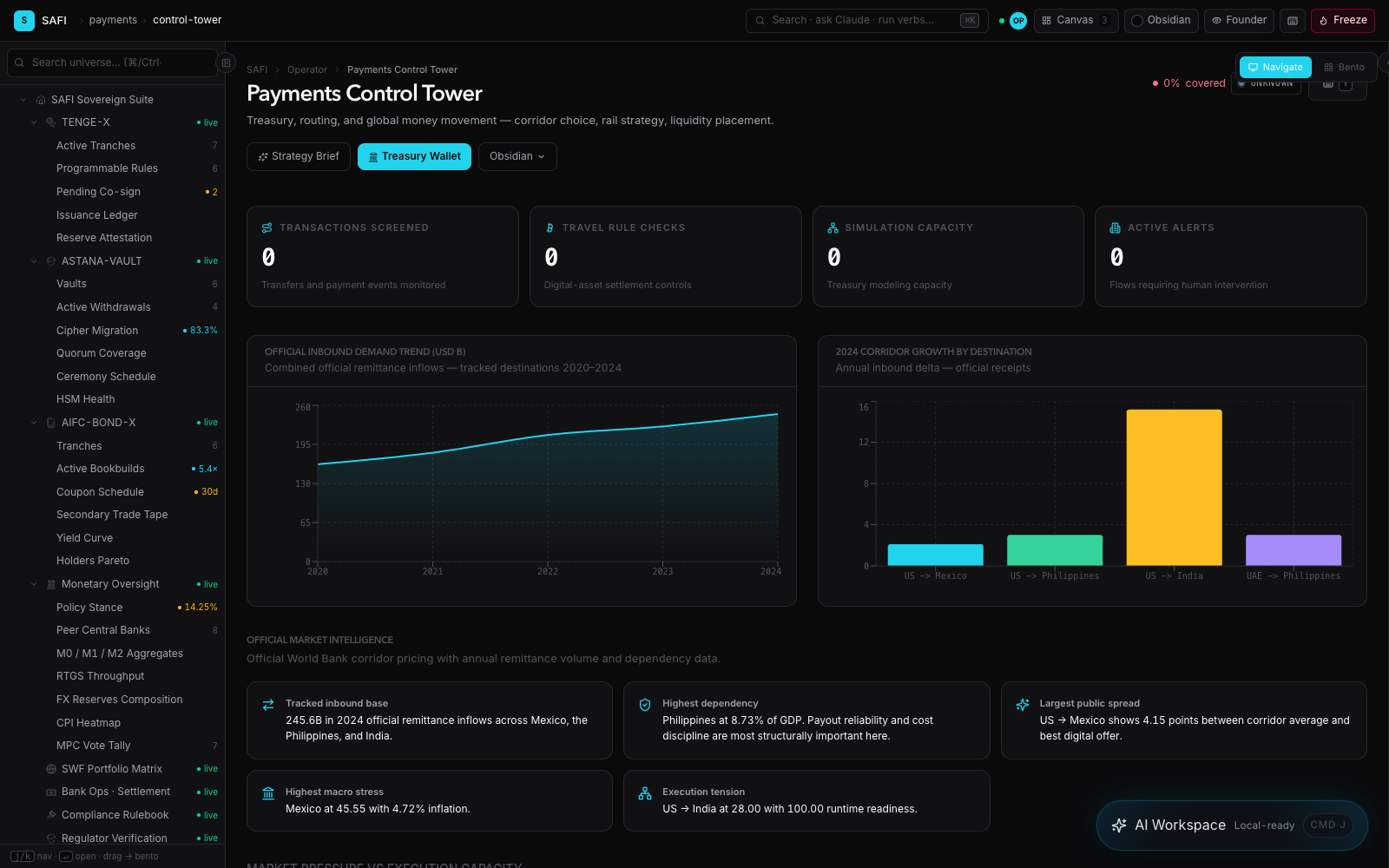
Money Rail
Programmable value movement with evidence-native control.
Workspace view plus analytics view: reserve posture, rule registry, co-sign workflow, corridor controls, exception handling, and signed operating evidence in one investor-reviewable surface.
Evidence governance
Powerful claims require evidence gates.
The website follows the Corporate Council Operating System created on May 12, 2026: departments, model seats, evidence gates, and investor-safe public language.
Corporate Council synthesis, internal reference 2026-05-12. Available in the qualified diligence room on request.
SAFI is presented as institutional infrastructure for partner-led operation, with licensing, custody, audit, KYC/AML, Sharia review, and insurance handled in the appropriate jurisdictional workstream.
Enabled/serviced asset value is not SAFI-owned AUM, committed capital, custody assets, backlog, or regulatory approval.
No token, sukuk, payment, remittance, custody, software-agent, securities, or investment activity without licenses, exemptions, regulated partners, counsel, and Sharia review where applicable.
Sovereign-grade posture
Architected for government-grade review without overclaiming certification.
SAFI should name the security frameworks serious Swiss and Gulf reviewers expect, while separating implemented controls, active workstreams, and target architecture. Status pills make the claim precise.
ML-DSA / FIPS 204Implemented path
ML-KEM / FIPS 203Migration workstream
CNSA 2.0 alignmentTarget posture
Hybrid signed bytesEvidence layer
FIPS 140-3 module pathPartner build path
HSM-bound key ceremonyCustody path
DISA STIG / TEMPEST-awareTarget posture
CMMC / IL5-IL6 controlsMapping target
FATF Travel Rule evidenceConsensus design
AAOIFI / IFSB workflowsEvidence rail
Audit / denial receiptsProof surface
HIPAA / HITRUST overlapControl overlap
Competitive truth table
SAFI is not another chain. It is the control layer the others assume.
Select a platform to compare public positioning against SAFI’s evidence-native rails. The point is not to attack incumbents; it is to show where SAFI integrates above them.
SAFI
Cross-product evidence and control infrastructure
- Native proof bundles and verifier exports
- AAOIFI / IFSB workflow evidence and Creusot formal-verification work
- PAYAGENT bounded authority and denial receipts
- Custody-control, tokenization lifecycle, compliance, payments, and venues in one rail family
Hyperledger Fabric / Corda
Strong enterprise ledgers; evidence and Islamic-finance controls remain custom builds.
- Enterprise permissioned networks are useful substrate options.
- Reviewer exports, Sharia governance, agent mandates, and lifecycle servicing are normally external applications.
- SAFI can integrate where these networks are selected by regulated partners.
Regulatory perimeter heatmap
Every jurisdiction needs a different licensed-partner path.
The heatmap shows where SAFI acts as software and evidence infrastructure while banks, custodians, transfer agents, venues, payment providers, auditors, and Sharia boards perform regulated roles.
JurisdictionIssuanceCustodyMoneyVenueRemittanceEvidence
Switzerland / FINMA
UAE / VARA · ADGM · DIFC
Saudi Arabia / SAMA · CMA
Bahrain / CBB
Malaysia / BNM · SC
Singapore / MAS
Tap or hover a cell for perimeter notes. Green indicates a stronger partner-path fit; gold indicates counsel-dependent or partner-dependent path; muted indicates out-of-scope or later-stage path.
Footnotes and claims boundary
Institutional claims should be traceable.
- Security references are architecture targets, implementation paths, or control mappings unless a formal certification is explicitly named in a signed diligence package.
- AAOIFI / IFSB references describe workflow alignment and evidence support. SAFI does not issue Sharia certifications; final review belongs to qualified Sharia boards and transaction counsel.
- Competitor comparisons are public-positioning summaries for investor discussion. Detailed source citations and legal review belong in the qualified diligence room.
- Market figures from BCG, IFSB, S&P Global Ratings, Deloitte, World Bank, and regulator publications are external market anchors, not SAFI forecasts or attainable share.
- Address for formal correspondence: 455 S Hudson St, Denver, CO 80246, United States. Email: info@safirails.com.
Qualified institutional access
Investor materials should be released through a gated diligence process.
Corporate Council directive: no public minimum ticket, no regulatory status claim without counsel, and no offering language outside a qualified investor workflow.
Professional investor, qualified institutional buyer, eligible counterparty, or equivalent status should be checked before detailed financial materials are shared.
Architecture summary, patent-safe module register, legal claims register, Sharia review process, financial model assumptions, and risk factors.
Jurisdictional counsel memo, Sharia review workflow, custody/control evidence, pilot scope, investor eligibility rules, and operating responsibilities.
Use direct controlled outreach for the Swiss CEO and qualified Gulf partners. Avoid broad public solicitation until counsel approves the communications path.
Contact us
For qualified institutional, partner, and diligence inquiries.
Use this contact route for formal correspondence, controlled diligence access, bank or custodian conversations, investor review, and jurisdiction-specific partner discussions.
Denver, CO 80246
United States
Source register
External facts used in the website.
BCG Global Asset Management Report 2026
IFSB Stability Report 2025 announcement
S&P Global Ratings sukuk market report
Deloitte tokenized real estate prediction
World Bank remittance flows note
VARA licensed activities
ADGM FSRA digital asset amendments
DFSA Crypto Token regime
QFC Digital Assets Framework 2024
ESMA MiCA
UK Digital Securities Sandbox
National Bank of Kazakhstan digital asset framework
FATF 2025 virtual assets update